
Blog
Published
Why Watching YouTube Wears Me Out | Introducing Paperman
A heavy YouTube viewer tries to pin down why watching feels so exhausting, and introduces Paperman, the app I'm building to work around it.
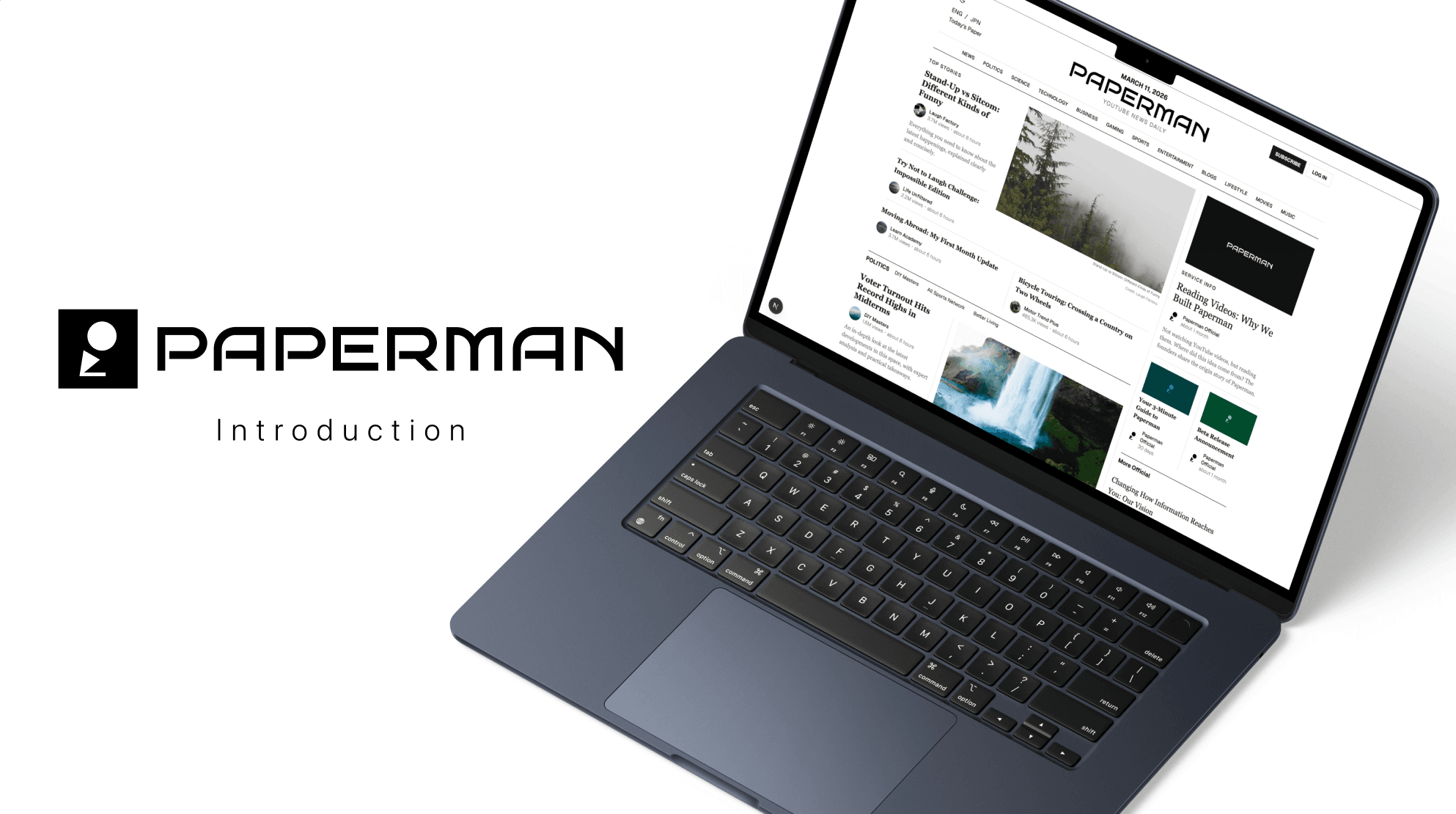
Hi, I'm MAIRU from Lambda Script, an independent studio.
This one is about the pain of YouTube.
I'm a heavy YouTube user. For the past few years, from the moment I wake up to the moment I fall asleep, if I have a spare minute, something is playing: a video, music, anything.
I've also, predictably, caught the Shorts habit.
I don't own a regular TV.
What I have instead is a TV without a broadcast tuner1, which in practice means an Android TV, and that's where I watch YouTube.
Family time in our living room used to belong to Japanese network variety shows. Now it belongs to Google.
I am enjoying every benefit of the new media age. It's great.
And yet, the more I use it, the more I notice the parts that hurt.
In this post I want to list those problems, and then talk about my attempt, as an indie developer, to hack around them with technology and a few ideas.
Why watching YouTube wears me out
First, why does YouTube feel tiring at all?
To be clear, it isn't that watching YouTube is no fun.
I have enormous respect for the people who make these videos.
The problem is almost the reverse: it's tiring because it's fun. There's something a little drug-like about it.
This is just my own sense of things, not a reproducible scientific finding, but here's the list I came up with:
- Thumbnails, polished to win the click, look like ads made by marketing professionals
- A video, by its nature, locks in your future: click, and the next few minutes, or hours, are spoken for
- There is a huge amount of long, high-quality, genuinely entertaining content
- Shorts are everywhere, and consuming them leaves my brain with no downtime
- Recommendations keep getting better, so every day repeats the one before
- Categories and genres barely function, so nothing gets sorted. It's a buffet that only serves meat
- Subscribing doesn't help, because I can't keep up with notifications, so I end up watching recommendations
- What I watch depends on my mood, and that gets in the way of running my own life
There are probably more, but that's the rough list.
Some of these are debatable.
A few may make you want to say, "Isn't that just a you problem?"
But people are weak.
Still, I don't want to jump to the easy answer of a digital detox, or of simply quitting YouTube.
Turning away from a new technology isn't a real solution to living with it.
So I'd rather face these head-on.
There are too many to go through one by one, and several overlap, so I'll pick a few.
Polished thumbnails, and choosing
The thumbnail is widely considered the single most important thing a creator controls when it comes to winning viewers.
Hover previews and titles help too these days, but the thumbnail image is still said to matter most.
- Showing your face gets more engagement
- A consistent look makes your channel recognizable at a glance
- Split layouts, like before-and-after, get more attention
- Put the video's strongest theme into text
- Keep the text short, thick, and big
- Push the contrast between background, subject, and text
- Don't repeat the title
Search for a minute and you'll find endless guides like "How to make thumbnails that explode your click-through rate."
In other words, there's a data-driven best practice, and creators apply it to compete for viewers.
But that's the creator's side of the story.
What does all this do to us, the viewers?
When looking for something to watch, the screen most of us look at most is Home, I think.
Every kind of video is laid out in a grid, and the feed keeps serving up more recommendations as you scroll, forever.
Television had time slots. Shows you liked, shows you'd never heard of, shows you didn't care about, shows you disliked, all mixed together, and the broadcaster decided when each one aired.
Maybe because of that, people learned to plan their own time around the schedule.
Nothing good is on right now, so I'll play that new game.
That comedian's show starts at 7, so we'll watch it over dinner.
The five-minute cartoon I watch every day is on at 8 a.m., so I'd better get up.
TV fit into daily life like that.
Today's YouTube instead shows you channels you care about, plus a flood of videos the algorithm has decided this account will probably like.
And it lays out countless thumbnails, each polished to win you over.
Like a buffet where every dish is a delicacy.
The algorithm is very good. Most of the videos really are interesting, and most of the time I'm happy with what it recommends.
In fact, back in 2018, YouTube's chief product officer said that more than 70% of watch time on YouTube came from recommendations2.
Which makes YouTube a TV where every show, from morning to night, is a good one.
That's an exaggeration, but pushing an argument to its extreme often shows you what it's really about.
So imagine a TV that is interesting all day, every day, forever. What happens to the people watching it?
My guess is that a steady stream of adrenaline and dopamine, delivered through the eyes, produces something like addiction.
Reading around a little, I found that in neuroscience there's a view that dopamine has less to do with liking something than with wanting it3.
Not watching because it's fun, but watching because you want more.
The "it's tiring because it's fun" feeling from earlier might live somewhere around here.
Life starts to slip, and YouTube stays on, chasing the next hit.
Especially whenever there's a spare moment. And it's free.
Time commitment and a tired brain
Humans get used to things.
That adaptability is how our species got this far.
Even someone like me, soaked in YouTube, adapts.
The brain gets used to being tired all the time, and starts trying to protect itself.
In my case, I started predicting the future before clicking a thumbnail.
Yes. Behind this link is a 1-hour-39-minute video.
I know it's going to be good.
But if I open it now, the rest of my plans are probably gone.
I started weighing that trade-off before every click.
Morning, lunch break, before bed. The time of day doesn't matter.
It feels like there are far more long videos on YouTube these days.
Hour-plus interviews, two-hour gameplay sessions, background music you can leave on all night.
And it feels like videos with high retention, the ones people watch to the end, get recommended more.
There's history behind that. In 2012, YouTube started using watch time, not just clicks, as a signal for recommendations4.
If you rank by clicks alone, videos that bait with a title and thumbnail rise to the top. So: treat videos that people actually finish as the good ones.
As reasoning, that's completely sound.
From the viewer's side, though, it also means that the videos people watch the longest are the ones that float up.
Creators know this too, so they study structures that keep retention high, and lengths that keep people watching.
Same pattern as the thumbnails.
On top of that, YouTube isn't just on phones anymore.
According to YouTube's CEO, people watch more than a billion hours of YouTube on TV screens every day, and for more than half of the top 100 channels, the TV is the screen where they're watched most5.
Our Android TV contributes diligently to that billion hours every single day.
A living-room TV, long videos, one after another.
Television with no time slots. Done.
At the other end from long videos are Shorts.
As of 2025, YouTube Shorts were averaging more than 200 billion views a day5.
A brain afraid of the "locked-in future" of a long video fills the gaps with clips a few dozen seconds long.
One clip is a few dozen seconds.
Stopping at one is very, very hard.
One study found that people who scored higher on short-video addiction tendencies also showed lower values on a frontal EEG measure linked to the executive-control part of attention, and scored lower on self-control6.
That's a correlation, so it doesn't prove that watching Shorts does this to you.
But as someone who can't stop scrolling Shorts, it doesn't feel like someone else's problem.
Long videos are heavy. Shorts don't stop.
Either way, you end up tired.
That, I think, is what I mean by a tired brain.
Sorting information, and mood
Item 6 on my list said that categories and genres barely function. Let me add a bit to that.
YouTube does, in fact, have categories.
When uploading, a creator can pick one, like Music, Gaming, or Education, and the developer API exposes them7.
But if the uploader doesn't set one, it doesn't really show up, and on the viewer's side it's buried deep in the UI.
I, at least, can barely remember ever finding a video through a category.
You could call that my problem, and maybe it is.
But I think most people on YouTube only ever look at the home feed.
The figure that more than 70% of watch time comes from recommendations2 isn't far from that feeling.
Subscriptions work in a similar way.
When you subscribe to a channel, notifications default to "Personalized," which means you only get notified about some uploads. YouTube decides which, based on things like your watch history, how much you watch that channel, how popular the video is, and how often you open notifications8.
So subscribing doesn't mean you'll hear about everything.
Whatever doesn't reach you gets watched only if it happens to show up on Home.
So what goes into my head always arrives in "whatever happened to show up" order.
News, then gameplay, then a workout, then somebody's latest controversy.
Information that comes in unsorted piles up in my head, still unsorted.
Then there's item 8: mood.
On days when I'm tired or down, I watch videos that match the mood.
Or I run the other way, to self-help videos or music.
Either way, it's what I want in that moment.
But it feels less like my own choice and more like the combination of my mood and the feed.
And the algorithm probably learns that too. (That part is my guess.)
There's a famous experiment on having too many options.
A tasting booth in a supermarket set out either 24 or 6 kinds of jam. The 24-jam display drew more people, but a far higher share of people actually bought jam when there were only 69.
YouTube's Home has a lot more than 24 jams.
Every one of them is excellent.
And there's no bottom.
Aza Raskin, who designed infinite scroll, told the BBC in 2018 that if you don't give your brain time to catch up with its impulses, you just keep scrolling, and expressed guilt about having created it10.
On my list I called YouTube a buffet that only serves meat.
To be more precise: a buffet of nothing but excellent meat dishes, with no dividers and no closing time.
You're full, and the next plate arrives anyway.
It would be harder not to get tired.
Could a daily newspaper make YouTube less tiring?
Writing all this reminded me of something.
I was raised by my grandparents.
So newspapers were always around when I was little.
Confession: I don't actually have a habit of reading print newspapers.
But I still read a lot of news and articles online, and the newspaper as a format feels familiar to me.
Line up what a newspaper is, and it's almost the exact opposite of YouTube's Home.
- It arrives once, at a set time
- The page has a fixed size
- Someone edits it and puts the important things first
- It's divided into sections: politics, business, sports, culture
- And you can finish it
That last one especially.
TV had time slots.
Newspapers have deadlines.
Both had an ending, a point where you're done for the day.
Maybe what YouTube is missing isn't more fun content. Maybe it's that "done for the day."
That's where Paperman started.
So should I just stop watching YouTube? As I said at the start, I don't think so.
There are so many great videos, and the work creators put in is genuinely something to admire.
What I want to change isn't the videos. It's the way in.
A front page that arrives once every morning, divided into sections, that you can actually finish.
Use that page as the way in, and go watch only the videos you really want to.
Honestly, I don't know yet whether that makes it less tiring.
So I decided to build it and find out.
Building Paperman
Paperman is an app that turns new uploads from the YouTube channels you subscribe to into a morning newspaper.
The tagline is "Your videos, your morning paper."
Roughly, it works like this:
- You connect your Google account, and it reads the channels you subscribe to on YouTube
- New uploads from those channels are laid out on the page, and for some of them, AI (Gemini) watches the video and writes an article
- Every morning at 6 a.m. (Tokyo time for the Japanese edition, New York time for the English edition) the edition closes and becomes a single front page
The front page is divided, in order, into the top story, articles by category, Shorts, other news, and "In Case You Missed It."
It's basically putting dividers into the buffet.
The articles follow a few rules of their own.
The headline doesn't just repeat the video title. No clickbait. The lead gives the conclusion. Never "In this video, …". And every article ends with a way back to the original video.
The spec says that being an edited article is the value of the product itself.
Article pages state clearly that the article was written by AI.
And about the daily deadline, the spec says this:
Being able to finish it is the newspaper experience, and the deadline is its precondition. A list that updates forever does not create the same experience.
I'd almost say I'm building the whole thing to say that one sentence.
I started in December 2025, and the project has passed 1,000 commits.
It hasn't been a straight line.
At first I tried to get new uploads through RSS.
In practice, after just a few requests it started returning 404s and was unusable. An error saying the requests had been restricted would have been one thing, but with a 404 you can't tell whether the video doesn't exist or you've been blocked.
I threw RSS out entirely.
I've rebuilt the pricing four times.
First three plans, then a waitlist, then a single plan, and now it has settled on "pay to generate articles, read for free."
At one point I announced a May 30 launch. I couldn't commit to a specific date anymore, so I took it back. The page now just says "Coming soon."
June, honestly, was mostly a stall.
Every indie developer knows that one.
And one more honest note: right now, Paperman doesn't turn videos longer than 30 minutes into articles.
Which means that 1-hour-39-minute video from earlier can't be rescued by Paperman either. Not yet.
How to handle long videos is still part of the experiment.
The rules I set for myself
While building it, I gave myself a few rules.
Not a replacement for the video
Paperman is not a tool for skipping videos.
Every claim in an article links back to that exact moment in the original video, down to the minute and second.
The page is one more way into the video.
Apps that use YouTube's API are bound by developer policies that forbid modifying, replacing, or disabling YouTube's features, content, or links11.
A way in, never a replacement.
That's a policy requirement, and it's also simply what I want.
Not infringing on creators' rights
Paperman uses a video's captions only when the channel owner has given permission. Even then, it gets them through YouTube's official API, using the owner's own authorization.
It doesn't use third-party transcription services. I once considered one, but switched to getting captions from the official API with the owner's permission, and dropped the idea.
If a channel owner asks for something to be taken down, Paperman accepts the request without requiring an account, hides the content right away, and deletes it within 7 days of confirming that they own the channel.
And it doesn't make money from articles built from material nobody gave permission for.
That's where the current pricing, "pay to generate, read for free," comes from.
Following YouTube's terms
Show YouTube's branding as the source. Use thumbnails without altering them. Refresh stored data every 30 days. Don't embed videos made for kids.
It's unglamorous, but each of these is written into the spec, and I follow them one by one.
Even for an indie app, getting sloppy here can cost you access to the YouTube API itself.
A new way for creators to reach viewers
I also want Paperman to be worth something to creators.
A page for each channel where its videos can be read as text. Delivered in both Japanese and English, translated. Discoverable through search.
People who don't have time to watch, or who speak a different language, could meet a creator through text first, and then come back to the video.
That said, this only means something once there are readers.
So for now, I'm not making it a big selling point.
Where things stand
Last, here's where things are, and what's next.
Paperman beta launch
There's no date for the beta yet.
May taught me a lesson, so this time I'm not writing one down.
Google's review of Paperman
Before launch, there are two reviews with Google.
One is OAuth verification. An app that connects to a Google account and reads YouTube data can't be released to the public until Google has verified it.
The other is the YouTube API audit. The YouTube API has a daily usage cap (quota), and at the current cap Paperman can handle only about 13 caption-based articles a day, and bring on only about 25 new readers a day.
Raising the cap means going through a compliance audit.
And if Paperman fails that audit, it loses API access, and the whole thing stops.
Honestly, that's pretty scary.
To creators
I haven't reached out to a single creator yet.
I plan to start asking, a little at a time.
If you're a creator and this sounds interesting, please get in touch.
YouTube is fun.
That's exactly why I don't want to end up hating it.
I don't know whether Paperman will solve every problem in this post.
But as a new way of living with YouTube, I think it's worth trying out in the real world.
If it works, I'll report back.
If it doesn't, I'll probably report back anyway.
That's it for today.
Footnotes
-
In Japan, owning a TV with a built-in broadcast tuner obliges you to pay the license fee for the public broadcaster NHK, so TVs without tuners have become popular in recent years. Since October 2025, however, even with a tuner-less TV or a phone, you need a license contract if you start receiving NHK's online streaming yourself (NHK Reception Contract Terms, effective October 1, 2025, NHK license fee amounts, Broadcast Act, Article 64; all in Japanese). ↩
-
Joan E. Solsman, "CES 2018: YouTube's AI recommendations drive 70 percent of viewing", CNET, January 10, 2018. Remarks at CES by Neal Mohan, then YouTube's chief product officer. ↩ ↩2
-
K. C. Berridge, T. E. Robinson, "Liking, wanting, and the incentive-sensitization theory of addiction", American Psychologist, 2016. ↩
-
Cristos Goodrow, "On YouTube's recommendation system", YouTube Official Blog, September 15, 2021. ↩
-
Neal Mohan, "Neal Mohan at Cannes Lions 2025: What 20 years of YouTube reveals about creativity's future", YouTube Official Blog, June 18, 2025. ↩ ↩2
-
T. Yan et al., "Mobile phone short video use negatively impacts attention functions: an EEG study", Frontiers in Human Neuroscience, 2024. ↩
-
"VideoCategories", YouTube Data API, Google for Developers. ↩
-
"Manage YouTube notifications", YouTube Help. ↩
-
S. S. Iyengar, M. R. Lepper, "When choice is demotivating: Can one desire too much of a good thing?", Journal of Personality and Social Psychology, 2000. ↩
-
"Social media apps are 'deliberately' addictive to users", BBC News, 2018. ↩
-
"YouTube API Services - Developer Policies", Google for Developers. ↩